

Electrodialyse à membrane bipolaire (EDBM)
Introduction
L’aspect initial de l’électrodyalyse à membranes bipolaires (EDBM) est la combinaison de l’électrodialyse utilisée pour la séparation de sels, avec celle utilisée pour le craquage de l’eau, pour la convertir des sels en leur bases et acides correspondants. Les membranes bipolaires améliorent le craquage de l’eau, permettant l’obtention de protons et ions hydroxydes séparés.
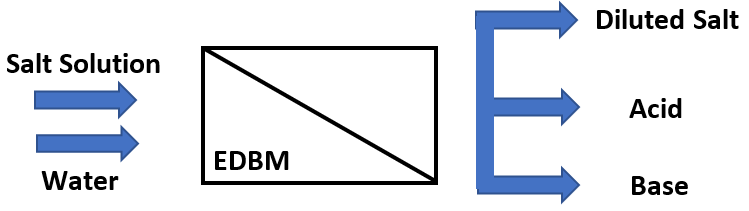
Fig.1,
Boite noire descriptive du procédé EDBM
Les membranes bipolaires sont un type spécial de membrane au propriétés échangeuses d’ions pour lesquelles une face est seulement perméable aux anions et l’autre aux cations. Contrairement aux autres procédés membranaires, l’EDBM ne s’utilise pas à des fins de séparation, mais afin de réaliser une réaction chimique a la jonction bipolaire de la membrane, où les couches cationiques et anioniques sont en contact direct.
Une membrane bipolaire répond aux exigences suivantes :
- Une excellente stabilité à long terme
- Une faible baisse passive de potentiel
- Un taux élevé de craquage de l’eau
- Une grande permsélectivité
- Ainsi qu’une bonne tenue mécanique
L’eau se sépare en ions hydroxyde et en protons. Ceux-ci sont séparés par migration à travers leur couche de membrane respective.
2H2O ↔ H3O+ + OH-
Contrairement au craquage s’effectuant aux électrodes durant une électrolyse, aucun gaz n’est utilisé ou formé comme sous-produit de cette réaction. L’électrodyalyse à membranes bipolaires (EDBM) peut remplacer l’électrolyse avec craquage de l’eau aux électrodes, et peut également avoir un large panel d’applications.
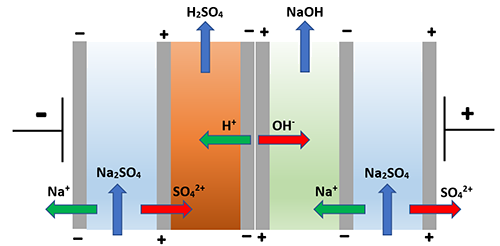
Fig.1, Représentation schématique de l’obtention d’une base et d’un acide à partir du sel correspondant par utilisation de membranes bipolaires.
La différence de potentiel nécessaire à la production electrodialytique de solutions d’une mole par litre est de 0.83 V, ce qui est équivalent à une consommation d’énergie de 22Wh. En comparaison, la production électrolytique d’une baisse de potentiel théorique est équivalente à une consommation d’énergie de 55Wh. D‘autres avantages de la technologie membranaire bipolaire incluent la relative simplicité de l’appareillage, la possibilité d’empilement des cellules ainsi que les faibles couts d’investissement.Tout particulièrement, la possibilité de séparer l’eau sans mettre en jeu des gaz réactifs, en a fait une technologie prometteuse déjà 15 à 20 ans auparavant.
-
Caractéristiques de l’EDBM
- Sépare l’eau en ions hydroxydes et en protons avec un voltage relativement faible
- Etant donne l’absence de réaction a l’électrode, aucune réaction d’oxydoréduction n’a lieu. Il n’y a donc pas de sous-produits.
- Produit de l’acide et une base à partir de sels organiques et inorganiques en un seul procédé.
- Contrôle le taux de concentration d’acide et de base.
- Différent du procédé électrolytique. Il n’y a pas besoin d’électrode entre chaque cellule, et donc moins de gaz sont générés.
- Produit moins de solution « déchet »
- Peut soutenir des opérations continues pour un temps long puisqu’aucun procédé de régénération, au contraire des procédés de résines échangeuses d’ions, n’est nécessaire
-
Exemples d’application de l’EDBM
- ・Production d’acide organique à partir de sel organique
- ・Production d’acides aminés à partir de sels d’acides aminés
- ・Production d’acides et de bases à partir de solutions déchets de sels.
- ・Production D’acides et de bases à partir de sels inorganiques.
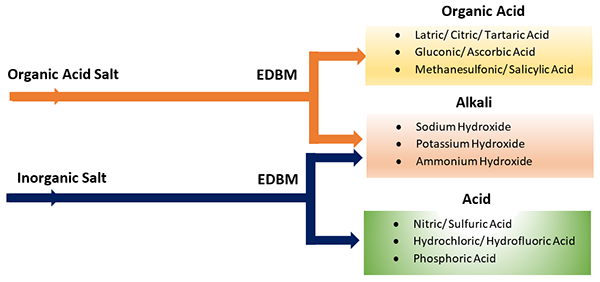
Fig. 2, Exemples de production avec l’EDBM