

Inversion d'électrodialyse (EDR)

- Présentation
- Fonction de processus
- Avantages et inconvénients
- Applications de l'industrie des procédés
1) Présentation
L'électrodialyse est un procédé membranaire qui utilise en alternance des membranes sélectives pour les anions (MA) et des membranes sélectives pour les cations (CM), placées entre une anode (+) et une cathode (-). En raison du champ électrique appliqué, les anions se déplaceront vers l'anode et les cations se déplaceront vers la cathode. Les anions sont arrêtés par les CM et les cations par les AM, créant un flux de processus avec une faible concentration en ions (diluant) et un flux de processus avec une concentration en ions élevée (concentré).
Une paire d'un CM et d'un AM et les deux zones entre ces membranes constituent une paire de cellules. Une paire de cellules est l'unité de base d'une pile et est répétée « (n) » fois. Le nombre de paires de cellules dans une pile réelle varie en fonction dele système d'électrodialyse, avec jusqu'à 600 paires de cellules dans un système typique à l'échelle de l'industrie.
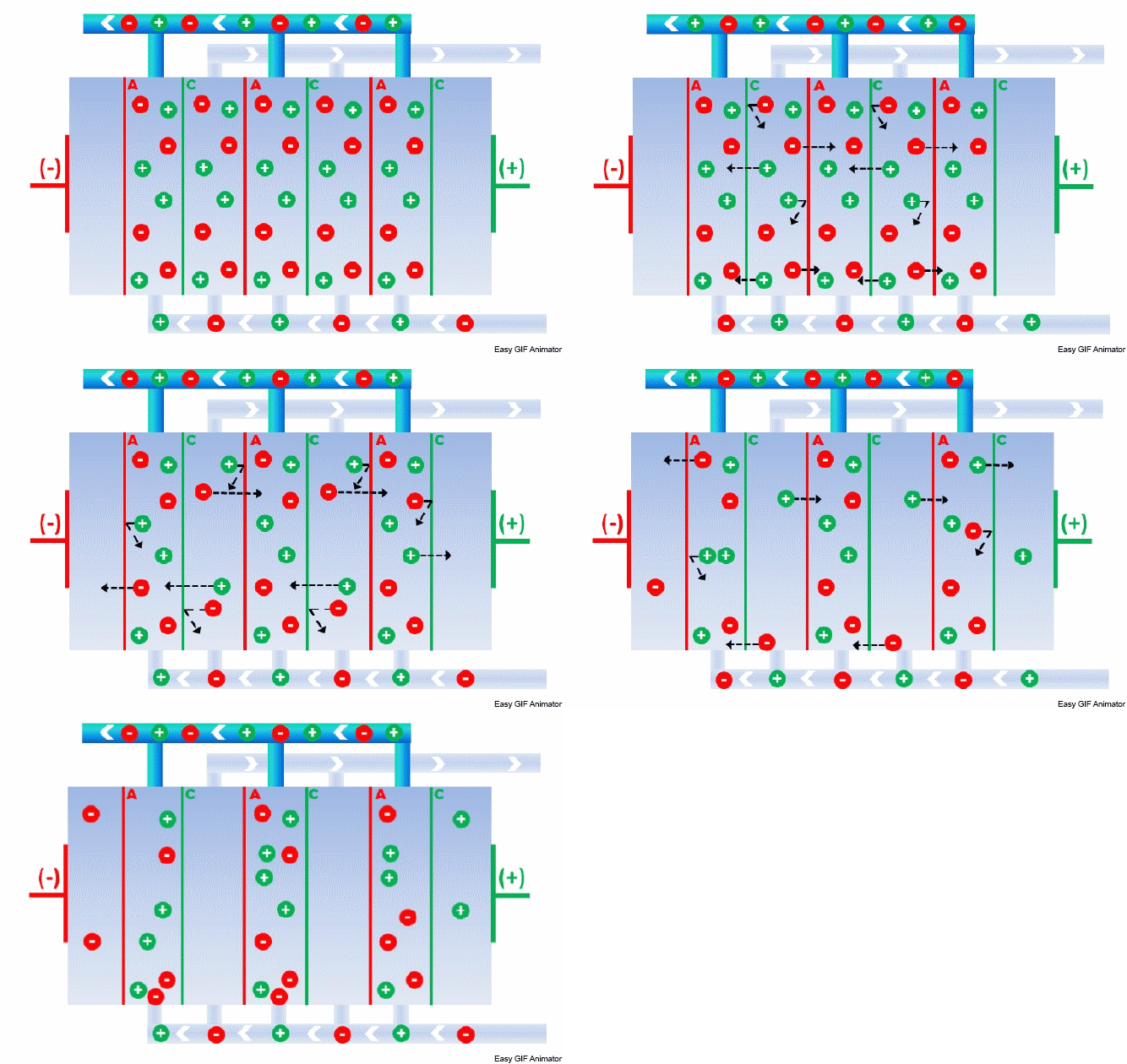
Dans l'électrodialyse, les solides en suspension qui portent des charges électriques positives ou négatives peuvent augmenter considérablement la résistance de la membrane et se déposent sur la surface de la membrane. Cependant, en électrodialyse, le problème a été éliminé dans une large mesure en inversant à certains intervalles de temps la polarité du potentiel électrique appliqué, ce qui entraîne une élimination des particules chargées qui ont été précipitées sur les membranes. Cette technique est appelée inversion d'électrodialyse (EDR).
2) Fonction de processus
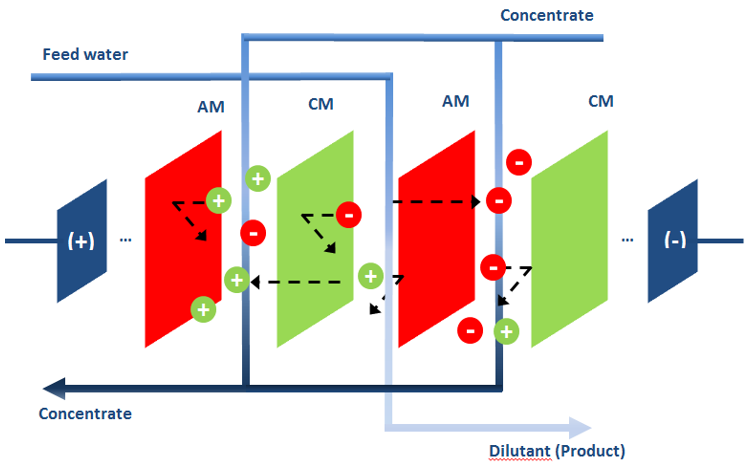
Fig.1, Description schématique du processus d'inversion de l'électrodialyse
Dans chaque pile EDR, il y a deux électrodes sur le côté extérieur qui sont immergées dans une solution aqueuse de sel qui est capable de conduire le courant électrique et permet de placer un champ électrique autour de la pile. La solution saline est pompée afin de maintenir l'équilibre ionique. Comme une solution saline (courant d'alimentation) se trouve également entre les membranes échangeuses d'ions, le champ électrique entraînera le transport d'ions. Dans les espaces entre les électrodes, marqués comme « diluant », les cations diffuseront à travers le CM vers l'électrode négative (cathode) tandis que les anions diffuseront à travers l'AM vers l'électrode positive (anode).
Les ions sortant de l'alimentation en diluant se déplacent vers la chambre d'alimentation en concentré voisine, ce qui entraîne une baisse de la concentration d'ions dans les chambres de dilution du procédé EDR. Dans les chambres à concentré, les cations tenteront de se déplacer vers l'électrode négative mais ils seront bloqués par l'AM et les anions essaieront de se déplacer vers l'électrode positive mais seront bloqués par le CM. Cela conduit à une augmentation de leurs concentrations respectives dans les chambres de concentré.
Dans l'EDR, la tension aux électrodes est inversée toutes les 30 à 60 minutes, ce qui inverse également le sens du transport des ions et provoque l'élimination de la surface de la membrane des substances chargées électriquement qui peuvent causer des dommages graves, voire irréparables. Il est généralement recommandé de retirer à l'avance,
- particules dispersées,
- colloïde
- acides humiques
- huiles et graisses
La durée de vie moyenne des membranes ED est comprise entre 5 et 7 ans.
3) Avantages et inconvénients
Avantages :
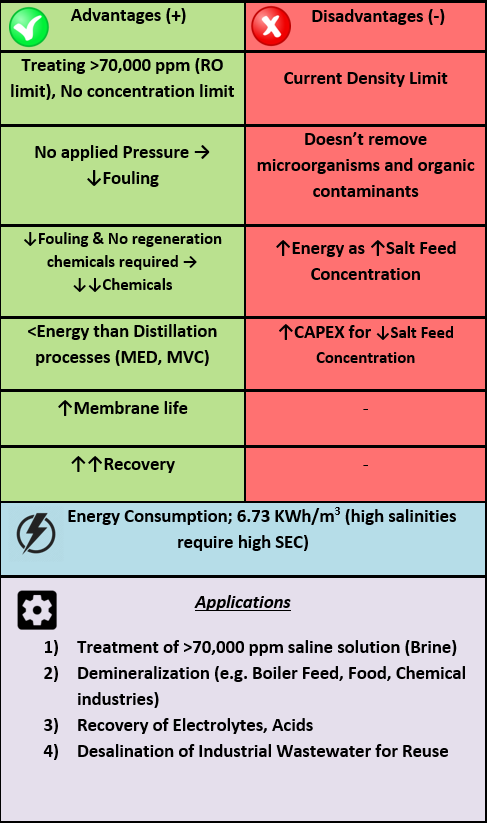
EDR a des caractéristiques avantageuses qui en font un succès. La première est la capacité de l'EDR à fonctionner avec une récupération d'eau très élevée grâce à son inversion de polarité qui permet le traitement, sans aucun produit chimique, des aliments avec des facteurs d'échelle de sel concentrés bien au-delà de la saturation. Avec l'ajout d'un antitartre EDR pousse sa tolérance au sel encore plus loin.
Contrairement à l'OI, qui est un processus piloté par la pression, l'EDR fonctionne en faisant circuler de l'eau d'alimentation sur la surface des membranes échangeuses d'ions, tandis qu'un champ électrique élimine les ions à travers ces dernières. L'EDR n'a pas de couche d'encrassement compacte comme l'osmose inverse, ce qui limite son efficacité de récupération.
Inconvénients :
Un inconvénient majeur est qu'au-delà d'une densité de courant particulière (Current Density Limit), la diffusion des ions à travers les membranes EDR n'est plus linéaire à la tension appliquée mais conduit à la dissociation de l'eau (l'eau se fendant en H+< /sup> et OH-) et diminue l'efficacité du système. L'EDR doit donc toujours fonctionner en dessous de la limite de densité de courant. Des procédures de mesure expérimentales sont disponibles pour déterminer le CDL pour un aliment particulier.
Un autre inconvénient de l'EDR est qu'il n'élimine pas les micro-organismes et les contaminants organiques, donc un post-traitement est toujours nécessaire si une eau de haute qualité est requise.
4) Applications de l'industrie des procédés
|
 Électrodialyse / Inversion ED