

Décharge de liquide minimale - MLD
- ZLD vs MLD
Pendant longtemps, le ZLD a été suggéré comme un moyen respectueux de l'environnement pour aider l'industrie à répondre aux exigences de rejet de plus en plus strictes et pour recycler ses flux d'eaux usées. Cependant, les processus ZLD sont
- techniquement complexe
- très cher
- pas nécessairement respectueux de l'environnement en raison du matériel et de l'énergie supplémentaires qu'ils nécessitent

Ainsi, de plus en plus d'utilisateurs finaux, afin d'améliorer leur empreinte hydrique, adoptent une approche de rejet liquide minimal (MLD) pour le problème de traitement des eaux usées en utilisant des technologies fiables basées sur la filtration qui peuvent atteindre une récupération d'eau élevée à une fraction de Les coûts de ZLD.
- Pourquoi MLD ?
Adopter une approche MLD pour votre processus peut aider les utilisateurs à minimiser considérablement leurs CAPEX et OPEX, car éliminer les 5 à 10 % finaux de liquide afin d'atteindre ZLD peut s'avérer extrêmement coûteux. Afin de mieux comprendre cela, nous prendrons le MD-MVC-Cristallizer de la page ZLD de Lenntech (Link to ZLD (MD-MVC-Crystallizer)), mais cette fois, nous allons commencer à compter la récupération totale d'eau à partir d'un seul passage SWRO (avec une récupération de 45%).
100 m3 d'eau d'alimentation →Prétraitement → RO à un seul passage (récupération de 45 %) → 100 (1-0,45) = 55 m3 Saumure → MD (75% de récupération) → 55 x (1-0,75) = 13,75 m3 Saumure → MVC (récupération de 90 %) → 13,75 x (1-0,9) = 1 375 m3 Saumure → Cristalliseur (50% de récupération) → 1,375 (1-0,5) = 0,68 m3 Saumure → Centrifugeuse de presse à bande
L'énergie requise pour ce schéma est,
100 m3 x 3,5 KWh/m3 (RO) + 55 x 6,57 KWh/m3 (MD) + 13,75 m 3 x 14,86 KWh/m3 (MVC) + 1,375 m3 x 50 KWh/m3 (Cristalliseur) = 350 KWh (RO) + 361,35 KWh (MD) + 204,33 KWh + 68,75 KWh = 984,43 KWh/100m3 eau d'alimentation p>
Donc jusqu'à MD le système a récupéré [100 m3 x 0,45 = 45 m3 (RO)] + [55 m3 x 0,75 = 41,25 m3 (MD)] = 86,25 m3 de perméat pour un coût de 350 KWh (RO) + 361,35 KWh (MD) = 711,55 KWh.< /p>
À partir du MVC, le système récupère [(100 – 86,25 =13,75) m3 x 0,9 = 12,375 m3 (MVC)] + [( 13,75 - 12,375 = 1,375) m3 x 0,5 = 0,688 m3 (Cristalliseur)] = 13,06 m3 de perméat pour un coût de 201,33 KWh (MVC) + 68,75 KWh (Cristalliseur) = 270,08 KWh.
Ce que nous obtenons est 711,55 KWh pour 86,25 m3 de perméat (Single RO – MD) et 270,08 KWh pour 13,06 m3 perméat (MVC & ndash; cristalliseur). C'est-à-dire que le (Ro-MD unique) produit du perméat à un coût de 711,55 KWh / 86,25 m3 = 8,25 KWh/m3 et le (MVC – Crystallizer) produit du perméat à 270,08 KWh / 13,06 m3 = 20,66 KWh/m3. Regardons ce point au tableau 1 et sa représentation graphique Figure 1,
Tableau 1, Valeurs de récupération et de SEC du schéma de traitement de l'eau RO-MD-MVC-Cristalliseur.
| Récupération (%) | SEC (kWh/m3) | ||
| RO | 45 | 3.5 | |
| MD | 86.25 | 6.57 | |
| MVC | 98.625 | 14.86 | |
| Cristallisoir | 99.313 | 50 |
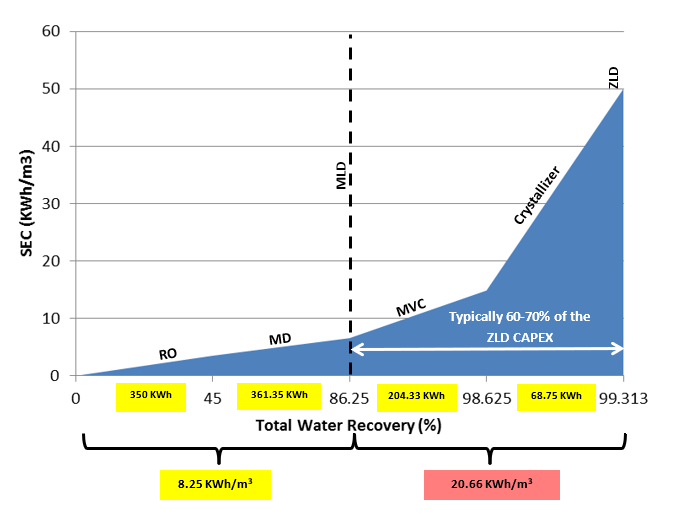
Fig.1, Récupération totale d'eau du procédé RO-MD-MCV-Cristallizer par rapport à leurs SEC respectives. Dans le graphique figurent également les valeurs de la demande d'énergie à chaque étape du processus ainsi que la demande d'énergie/m3 du MLD et la scène ZLD. Le processus atteint un stade MLD juste après le MD et un ZLD après le cristalliseur.
Comme nous pouvons le voir, la demande d'énergie pour une récupération supplémentaire après MD augmente de 20,66 KWh/m3 / 8,25 KWh/m3 sup> = 2,50 ou 250 % ! À ce stade, chaque utilisateur doit décider si le pas en avant supplémentaire en vaut vraiment la peine. D'autant plus que cette partie du processus ZLD va coûter généralement 60 à 70 % du CAPEX total.
ZLD peut être utile lorsque des législations strictes sont présentes ou dans les régions du monde sensibles à l'eau, lorsque chaque goutte compte mais est très difficile sur le plan économique. Les dernières étapes nécessaires pour réaliser une ZLD complète peuvent presque doubler les coûts.
Un excellent exemple réel de MLD a eu lieu à l'usine d'assemblage de véhicules General Motors (GM) à San Luis Potosi, au Mexique. L'usine est située dans une zone aride et éloignée sans cours d'eau récepteur ni égout municipal disponible pour évacuer les eaux usées. En utilisant une combinaison de technologie RO, un processus d'adoucissement chimique à haut débit et d'autres technologies, l'usine récupère et réutilise 90 % de ses eaux usées tertiaires, les 10 % restants des déchets liquides étant déversés dans des bassins solaires adjacents pour évaporation.
D'autres options technologiques telles que HPRO, EDR, FO et MD, leurs combinaisons et hybrides peuvent également augmenter la récupération élevée (70-80%) et elles nécessitent beaucoup moins d'énergie que l'évaporation thermique, réduisant la taille de cette dernière et par conséquent le cristalliseur (si ZLD est requis)
- Coûts réduits & impact environnemental
L'argument le plus fort dans la poursuite de MLD est la réduction des CAPEX et OPEX par rapport à la conception ZLD. Les coûts des procédés membranaires et de filtration sont proportionnellement minimes en comparaison des technologies thermiques ZLD.
Les nouvelles avancées technologiques peuvent minimiser la taille des évaporateurs et des cristalliseurs et peut-être même éliminer leur utilisation. Dans le même temps, ces mêmes technologies ont une capacité de récupération plus élevée. D'autant plus que certains d'entre eux peuvent utiliser la chaleur résiduelle, il est très important de les considérer pour des avantages supplémentaires en termes de réduction des coûts et d'efficacité dans une conception de processus MLD.
- Évaluation des besoins MLD
Afin de comprendre si un certain cas est approprié pour la MLD, la première question est de savoir si la réutilisation de l'eau est nécessaire. Si c'est le cas, alors l'approche MLD pourrait être ce qui est nécessaire. Si les législations locales doivent être respectées concernant le rejet des effluents, alors le MLD peut être une partie de la solution qui peut inclure ZLD/bassins d'évaporation/injection d'eau souterraine.
La prochaine étape consiste à identifier vos flux de déchets en termes de débit, leurs contaminants et leurs concentrations respectives. Tous les cas ne nécessitent pas le même traitement. En vérifiant les flux de déchets, nous pouvons calculer une approche plus économique et durable pour chaque cas. Par exemple, les condensats et les eaux pluviales nécessitent très peu de traitement, tandis que les flux de déchets contenant de fortes concentrations de composés organiques, de sels, de métaux et de solides en suspension sont plus susceptibles de nécessiter un traitement approfondi.
Du point de vue des besoins en eau, des législations et des exigences environnementales, ainsi que du budget CAPEX et OPEX, MLD peut s'avérer être une bonne option pour un large éventail de sites industriels et municipaux qui souhaitent améliorer de manière rentable leur empreinte eau.< /p>