

Zero Liquid Discharge - ZLD
- Qu’est-ce qu’un procédé ZLD ?
Un ZLD est un procédé de traitement qui a pour but d’éliminer tous les rejets liquides d’un système. L’accent d’un ZLD est mis sur une réduction économiquement viable du volume d’effluents, et sur une production d’eau propre qui pourra être réutilisée.
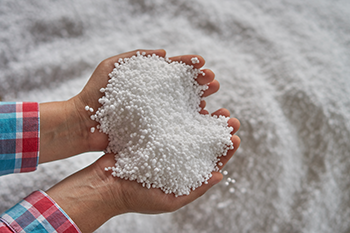
Les technologies ZLD consistent traditionnellement en des technologies telles que des concentrateurs de saumure et des cristalliseurs qui utilisent l’évaporation thermique permettant ainsi de produire, à partir d’eau salée, une eau hautement purifiée, et un produit sec solide prêt à être envoyé en décharge ou revalorisé. Bien que les systèmes d’évaporation/cristallisation soient les plus utilises en procédés ZLD, d’autres technologies (ED/EDR, FO et MD qui seront décrites ultérieurement) avec de hauts rendements gagnent du terrain et sont utilisées en différentes combinaisons afin de diminuer les couts et augmenter l’efficacité des systèmes.
L’augmentation des restrictions gouvernementales concernant le rejet d’effluents chargés en sels à cause de leur impact environnemental rendent les ZLD nécessaires lorsque l’eau est rare ou que les plans d’eau locaux sont protégés par la loi. Ainsi, beaucoup d’industriels et autres producteurs d’effluents salés qui jusqu’à maintenant les rejetaient dans un réservoir d’eau naturelle proche, dans la mer ou bien vers une station d’épuration cherchent de nouveaux moyens pour remédier à ces problèmes.
- Pourquoi choisir un ZLD
L’implication des industriels producteurs d’effluents salés est double. Beaucoup de procédés industriels nécessitent de l’eau, qu’ils contaminent puis relâchent dans l’environnement, causant des dommages irréversibles sur celui-ci.
En Inde, durant la décennie passée, de lourdes contaminations des eaux locales par des effluents industriels ont entrainé des restrictions réglementaires rendant le ZLD nécessaire pour assurer la pérennité de leurs rivières et plans d’eau. En Europe et en Amérique du Nord, l’augmentation de l’utilisation de procédés ZLD résulte des couts importants liés à l’évacuation des effluents. Ces couts augmentent de manière exponentielle par le biais de pénalités financières gouvernementales et du fait du cout des technologies d’élimination des effluents.
Le ZLD peut également être utilisé pour la récupération de ressources utiles à partir des effluents, pouvant être vendues ou réutilisées au sein du procédé industriel. Quelques exemples :
- Génération de sulfate de potassium (K2SO4) fertilisant, dans une mine de sel.
- Concentration d’une solution de soude de (NaOH)50 à 99%
- Récupération de sulfate de sodium (NaSO4) pur et vendable issu d’une usine de fabrication de batteries.
- Reduction du cout de traitement des effluents d’une mine de charbon en récupérant du chlorure de sodium pur (NaCl) qui peut être vendu pour le salage des routes.
- Du Lithium (Li) a été trouvé dans des saumures de champs pétrolifères des Etats-Unis à des concentrations similaires à celles des salars Sud-Américains.
- Du gypse (CaSO4.2H2O) peut être récupéré des eaux de mine et effluents de désulfuration, qui peuvent ensuite être vendus pour la fabrication de plaques de plâtre (placoplâtre).
Les procédés ZLD présentent d’autres avantages :
- La diminution du volume des effluents diminue les couts de la gestion des déchets.
- Recyclage de l’eau sur site, diminuant ainsi le besoin de prélèvement d’eau et de traitement lié
- Réduit le cout de transport d’élimination hors site et les risques environnementaux liés.
Tableau 1, Pourquoi choisir un ZLD ?
| 1. Respect des réglementations gouvernementales strictes sur l'élimination de la saumure |
| 2. Récupération de matériaux précieux dans les flux de déchets |
| 3. Diminution des volumes de déchets et des coûts de gestion |
| 4. Recyclage de l'eau sur place |
| 5. Réduction des coûts des camions pour l'élimination hors site |
- Les applications des procédés ZLD
Il existe une grande diversité de sources d’effluents, parmi lesquelles :
- Les purges de tours de refroidissement de l’industrie lourde et les centrales.
- Les courants de régénération des colonnes échangeuses d’ions, particulièrement en industrie agroalimentaire.
- Les effluent de désulfuration des fumées.
- Les effluents des installations municipales de production d’eau potable.
- La réutilisation des eaux de process agricoles, industrielles et municipales.
- Les effluents variés des industries textiles, de transformation du charbon, agroalimentaires ou de fabrication de batteries.
Nous pouvons nous référer en particulier aux applications suivantes (Tableau 2),
Tableau 2 : Application des procédés ZLD en traitement de l’eau
| Rejet du système de membrane(NF, MF, UF, RO) | Drainage de la mine |
| Désulfuration des gaz de combustion (FGD) Souffler / Purge | Raffinerie, gaz à liquide(GTL), et du charbon au produit chimique (CTX) Eaux usées |
| Eau produite(Conventionnel, Fractionnement, SAGD) | Purge de l'épurateur |
| NOx Eau d'injection | Déchets de déminéralisation |
| Cycle combiné de gazéification intégré(IGCC) Eau grise | Lixiviat d'enfouissement |
Les sources de décharge peuvent être davantage classées en fonction du volume et de la complexité. Une solution ZLD doit prendre ce dernier en considération ainsi que l'emplacement du flux de déchets.
- Facteurs déterminants des procédés ZLD
Les facteurs les plus importants, déterminants du design d’un ZLD sont :
- Les contaminants spécifiques de l’effluent
- Le volume du matériau dissous
- Le débit nécessaire
Les Constituant chimiques importants sont présentés dans le tableau 3.
Tableau 3, Constituants chimiques typiques
| Sodium (Na+) | TDS/TSS | Phosphate (PO43-) | Strontium (S2+) | Sulfate (SO42-) |
| Potassium (K+) | COD/TOC/BOD | Ammonia (NH3) | Oil & Grease | Fluoride (F-) |
| Calcium (Ca2+) | pH | Boron (B+) | Barium (Ba2+) | Nitrate (NO3-) |
| Magnesium (Mg2+) | Chloride (Cl-) | Alkalinity | Silica | - |
Ces paramètres doivent être mesurés précisément avant une demande de devis afin d’estimer précisément le cout du système. Si l’alimentation est amenée à varier en débit et en concentration de contaminants, des réservoirs tampon lissent les pics.
- Couts opératoires
Chaque technologie de la chaine ZLD a un certain cout d’achat, mais un paramètre important pour calculer les couts et éventuellement le retour sur investissement sont les couts opératoires. Les OPEX (OPeration EXpenses) peuvent drastiquement changer en fonction du procédé sélectionné, particulièrement en ce qui concerne la puissance électrique et les installations de production de vapeur. Pour un investissement à long terme, les avantages et inconvénients de chaque choix doivent être mesurés, ainsi que le meilleur fonctionnement possible pour chaque entreprise et leurs employés. Cela aidera à avoir un cout d’investissement initial comparés à un cout d’investissement à long terme.
|
Technologie de traitement de la saumure |
Énergie électrique(KWh/m3) |
L'énérgie thermique (kWh/m3) |
Total El.Équivalent(kWh/m3) |
Taille typique (m3/d) |
Investissement ($/m3/d) |
max TDS (mg/L) |
|
MSF |
3.68 |
77.5 |
38.56 |
<75,000 |
1,800 |
250,000 |
|
MED |
2.22 |
69.52 |
33.50 |
<28,000 |
1,375 |
250,000 |
|
MVC |
14.86 |
0 |
14.86 |
<3,000 |
1,750 |
250,000 |
|
ED/EDR |
6.73 |
0 |
6.73 |
/ |
/ |
200,000 |
|
FO |
0.475 |
65.4 |
29.91 |
/ |
/ |
200,000 |
|
MD |
2.03 |
100.85 |
47.41 |
/ |
/ |
250,000 |
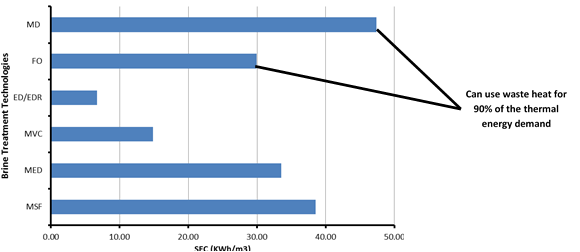
Tableau 4, Consommations d’Energie Spécifique (SECs) des technologies de traitement d’eaux saumurées, Distillation Flash Multi-Étagée (MSF), Distillation à multiple effet (MED), Recompression mécanique de la vapeur (MVC), Electrodialyse (ED/EDR), Osmose Directe (FO), Distillation sur Membrane (MD).
Les valeurs de consommation énergétiques sont des moyennes issues de 13 études comparatives effectuées sur les technologies ZLD, réalisées entre 2002 à 2017. Des éclaircissements sont nécessaires pour l’ED/EDR, la FO et la MD.
1) La SEC de l’ED/EDR dépend de la salinité de l’alimentation, étant donné que des salinités plus élevées nécessitent des SEC plus élevées.
2) La SEC d’une FO dépend de la solution d’extraction et de la méthode de régénération. La plupart des publications présument l’utilisation de sels thermolytiques et leur régénération à une température de 60 °C. 90% de l’énergie thermique nécessaire peut être obtenue par récupération de chaleur si disponible.
3) La SEC de la MD dépend de sa configuration. La configuration la plus commune de MD dans les études est la MD a contact direct (DCMD) étant donne sa simplicité. Finalement
4) l’équivalent électrique total a été obtenu de la manière suivante : Total El. Equivalent = El. Energy + 0.45 x Thermal Energy étant donne l’efficacité d’une centrale moderne (selon les publications pertinentes).
Fig.1 Graphe de comparaison des différentes Technologie de traitement d’eaux saumurées (Voir explications dans la description du tableau 4)
En derniere remarque, pour une analyse cout-benefice, vous devez toujours prendre en consideration les facteurs du type :
- Taxes ou frais d’achats additionnels
- Couts fonctionnels possibles au sein de l’aire d’installation
- Permis ou frais liés a la réglementation environnementale
- Essais de conformité réguliers
- Dimensionnement de base d’un ZLD – Schéma fonctionnel d’un ZLD
Malgré la variabilité de la source d’un effluent, un système ZLD est généralement composé de deux étapes, représentées sur la Figure 1.
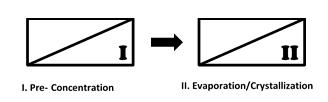
Fig.2, ZLD Basic Blocks
- Préconcentration ; Ces technologies concentrent l’effluent et sont capables de récupérer 60 à 80 % de l’eau. La préconcentration d’un effluent est habituellement réalisée par des concentrateurs à membrane ou par électrodialyse (ED).
- Evaporation/Crystallisation; Durant l’étape suivante, des procédés thermiques évaporent l’eau restante, la récoltent, et l’envoient en reuse. Le résidu restant est envoyé vers un cristalliseur, qui fera bouillir l’eau jusqu’à la cristallisation des impuretés et par filtration ils sont récoltés sous forme solide.
6.1. Préconcentration
La préconcentration de l’effluent est une étape très importante étant donné qu’elle réduit le volume de déchet permettant ainsi de baisser significativement la taille de l’étape très couteuse d’évaporation/cristallisation. Cette étape est habituellement réalisée par électrodialyse (ED) ou par procédés membranaires consistant en de l’osmose directe (FO) et de la distillation sur membrane (MD) (Figure 3).
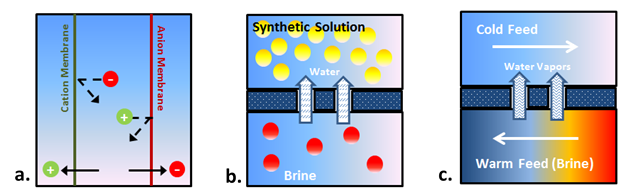
Fig.3, Technologies de traitement des eaux saumurees, (a) electrodialyse, (b) Osmose directe, (c) Distillation sur membrane.
L’ED, la FO et la MD peuvent fonctionner de manière efficace a des concentration en sels bien supérieure à celles possibles en RO (150 000 ppm, 200 000 ppm, 250 000 ppm et 70 000 ppm respectivement).
6.1.1. Electrodialyse/ Electrodialyse inverse
L’électrodialyse est un procédé membranaire qui utilise des électrodes afin de créer un champ électrique poussant les ions négatifs et positifs à travers des membranes semi-perméables sur lesquelles sont greffées des espèces respectivement chargées positivement ou négativement. L’ED est utilisée en étages multiples pour concentrer l’eau chargée aux niveaux de saturation. Elle est souvent utilisée avec l’Osmose inverse (RO) pour des hauts taux de récupération d’eau. L’ED diffère de la RO du fait qu’elle élimine les ions mais pas l’eau, et vice versa pour la RO. Ainsi, la silice et les composes organiques dissous ne sont pas éliminés par l’ED, ce qui est important si le courant propre est destiné à être réutilisé. L’ED et la RO nécessitent une élimination des MES et composes organiques de leur eau d’alimentation.
Electrodialyse inverse (EDR)
En EDR la polarite des électrodes est inversée plusieurs fois par heure, ainsi l’eau d’arrivée et le concentrat sont échangés au sein de la cellule afin d’éviter le colmatage de celle-ci.
6.1.2. L’Osmose Directe (FO)
FO L’osmose directe est un procédé membranaire osmotique utilisant une membrane semi perméable sur laquelle, au contraire de la RO, n’est pas appliquée une pression afin d’effectuer la séparation de soluté comme des ions, des molécules ou des particules plus larges. Cela veut donc dire qu’on utilise beaucoup moins d’énergie pour ce procédé en comparaison a la RO. En général, la FO utilise de l’énergie thermique et électrique. L’énergie thermique peut être remplacée par une énergie résiduelle de faible qualité trouvable dans la plupart des industries ou à proximité de celles-ci.
6.1.3. La Distillation sur Membrane (MD)
MD La MD est un procédé thermique utilisant des membranes hydrophobes. La force motrice de la méthode est le gradient de pression des deux cotes des pores de la membrane, permettant un transport de matière et de chaleur des composés volatiles en solution (ex : eau). La simplicité de la MD, et sa possibilité d’utiliser de la chaleur résiduelle et/ou des sources d’énergie alternatives, comme l’énergie solaire ou géothermale, lui permettent d’être combinée avec d’autres procédés dans des systèmes intégrés, faisant de celle-ci une technique de séparation prometteuse.
6.1.4 L’importance de la préconcentration dans un procédé ZLD
Les technologies de préconcentration ont des rendements très élevés mais habituellement pas assez pour amener les effluents a des concentrations de saturation au contraire des technologies typiques d’évaporation thermique. Donc pourquoi sont-elles si importantes ? La raison est le cout d’investissement et d’exploitation des évaporateurs/cristalliseurs. 1) Etant donné la nature corrosive des effluents chargés en sels, des alliages de plus en plus résistants sont nécessaires afin de contrer la corrosion lors de l’augmentation des concentrations. Cela veut donc dire que plus le module d’évaporation/cristallisation est grand, plus le cout d’investissement sera élevé (qui peut être de 60-70% du cout du procédé entier). 2) Une grande demande en énergie liée a l’augmentation du point d’ébullition de l’effluent lorsque la concentration augmente. Ces deux points seront expliqués de manière plus analytique dans les pages de Lenntech relatives à l’évaporation/cristallisation.
Essayons de formuler un exemple visuel de la situation. Supposons que nous avons 100m3/j d’eau chargée et que nous voulons la traiter avec une combinaison MD-MVC-Cristalliseur. Supposons que nous avons (approximations grossières des valeurs disponibles dans les publications liées),
- Une MD (75% de rendement) /chaleur résiduelle disponible sur site => 90% de l’Energie Thermique peut être remplacée par de l’énergie résiduelle => La consommation énergétique baissera de 47.41 à 6.57 KWh/m3
- Une MVC avec 90% de rendement => une moyenne de 14.86 KWh/m3
- Un cristalliseur avec un rendement de 50% => une moyenne de 50 KWh/m3
Donc, en prenant en compte les valeurs précédentes, regardons comment le procédé s’en sort.
100 m3 de saumure → MD (-75%) → 25m3 de saumure → MVC (-90%) → 2.5 m3 de saumure → Cristalliseur (-50%) → 1.25 m3 de saumure → Envoi vers une centrifugeuse ou un filtre presse à bande.
La consommation énergétique est donc : 100 m3 x 6.57 KWh/m3 + 25 m3 x 14.86 KWh/m3 + 2.5 m3 x 50 KWh/m3 = 657KWh + 371.5 KWh + 125 KWh = 1153.5 KWh/100 m3 de saumure
Si nous n’avions pas d’étape de préconcentration et donc si nous avions directement envoyé la saumure dans l’évaporateur, nous aurions la demande énergétique suivante :
100 m3 x 14.86 KWh/m3 + 10 m3 x 50 KWh/m3 = 1486 KWh + 500 KWh = 1986 KWh/ 100 m3 de saumure.
1986 KWh (MVC-Cristalliseur)/ 1153.5 KWh (MD-MVC-Cristalliseur) = 1.72 ou 172% d’augmentation de la consommation énergétique du procédé sans prétraitement.
Tableau 5, Rendements relatifs en eau (%) de chaque combinaison (avec et sans préconcentration) avec les SECs pour chaque technologie.
| ZLD avec pré-concentration | ZLD sans pré-concentration | ||||
| Récupération (%) | SEC (kWh/m3) | Récupération (%) | SEC (kWh/m3) | ||
| MD | 75 | 6.75 | 0 | 0 | |
| MVC | 97.5 | 14.86 | 90 | 14.86 | |
| Cristallisoir | 98.75 | 50 | 95 | 50 | |
La visualisation graphique du tableau 5 nous donne la figure 4,
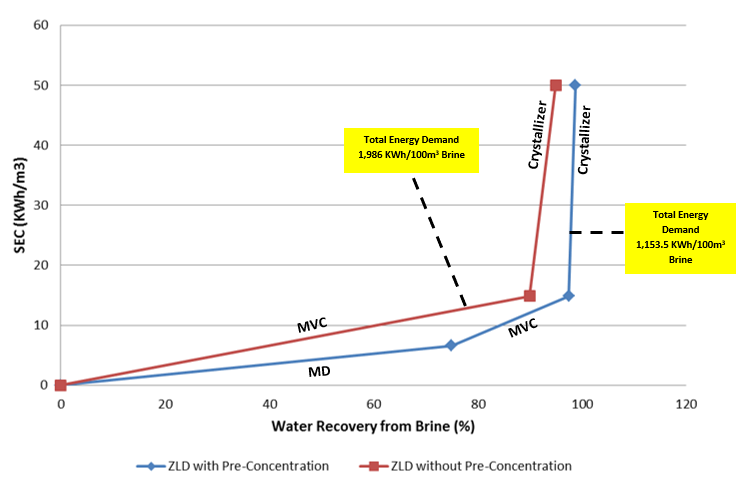
Fig.4, Rendements relatifs en eau (%) de chaque combinaison (avec et sans préconcentration) avec les SECs pour chaque technologie.
Donc, l’étape de préconcentration ne diminue pas seulement les couts énergétiques de moins de la moitié, mais augmente également la possibilité d’obtention d’un meilleur rendement de récupération d’eau du système. Sans mentionner la possibilité de réduction de la taille de la MVC de 100 à 25m3 et du cristalliseur de 10 à 2.5 m3 qui impliquent des économies énormes en investissement et fonctionnement.
A partir d’ici, nous devons mentionner le concept de « Minimal Liquid Discharge (MLD) », soit en français « Rejets liquides minimaux ». Un MLD est un système a haut rendement moins pousse qu’un ZLD étant donne les couts et la complexité de celui-ci. Le MLD est détaillé dans une page Lenntech séparée.
6.2 Evaporation et Cristallisation
Apres préconcentration de l’effluent, l’étape suivante est l’utilisation de procédés thermiques ou d’évaporation afin de générer un déchet solide et réutiliser l’eau évaporée. L’évaporation consiste essentiellement en un transfert thermique vers un liquide bouillant avec pour objectif de concentrer un soluté non volatil contenu dans un solvant, qui est généralement de l’eau, par ébullition de cette dernière. Le procédé d’évaporation s’arrête normalement juste avant précipitation du solide, sinon il est considéré comme étant de la cristallisation.
L’évaporation à film tombant est une méthode d’évaporation efficace énergétiquement parlant, qui concentre l’eau jusqu’au point de cristallisation initial (Super saturation). En ajoutant de l’acide, on neutralise la solution, ce qui a pour effet, lorsqu’on la chauffe, de prévenir le colmatage et la détérioration de l’échangeur de chaleur. Une désaération est également souvent mise en place afin de relâcher le dioxygène, dioxyde de carbone ou d’autres gaz dissous non condensables.
La saumure sortante de l’évaporateur est envoyée dans un cristalliseur à circulation forcée dans lequel l’eau est concentrée au-delà de la valeur de solubilité des contaminants et forme de formation des cristaux. Le produit sortant est asséché par un filtre presse ou une centrifugeuse et le concentrat (liqueur mère) est renvoyé dans le cristalliseur.
Le condensat récupéré (eau) des trois étapes retourne au procédé, éliminant les rejets de liquides dans le système. Si des composes organiques sont présents, un traitement de finition du condensat peut être nécessaire avant réutilisation. L’eau est ensuite envoyée dans un réservoir.
Les déchets solides sont alors soit réutilisés, soit envoyés en décharge.
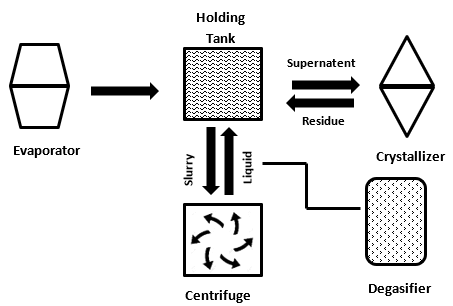
Fig.5, Phase d’Evaporation/Cristallisation d’un ZLD
 Zero Liquid Discharge (ZLD)